
Electric Cars
15th July 2026
Why Are Electric Cars So Popular?

Electric cars have moved from niche to mainstream.
In the first half of 2026 alone, more than 284,000 new electric cars were registered in the UK, making up around one in four new cars sold. As more manufacturers launch new models and charging continues to improve, it’s easy to see why more people are making the switch.
In our latest survey of more than 6,000 Tusker drivers, 96% of EV drivers were satisfied or very satisfied with their electric car. Among non-EV drivers, 71% expect to drive electric within four years, and 35% would choose an EV if changing their car tomorrow.
So, what’s driving their popularity?
More choice than ever
Not long ago, there were only a handful of electric cars available. Today, almost every major manufacturer offers an electric range, with everything from compact city cars to family SUVs and performance models. The number of electric models has more than doubled in the last five years.
That means drivers don’t have to compromise. Whether you’re looking for something practical, spacious or packed with the latest technology, there’s likely to be an EV to suit your lifestyle.
Did you know?[1]
- 🚗 Nearly 1,000 electric car models are now available worldwide, meaning around 40% of every new car model on sale worldwide is now electric.
- 🌍 1 in 4 new cars sold globally in 2025 was electric.
- ⚡ More than 20 million EVs were sold worldwide in 2025.
- 📈 Around 150 new electric models are expected to launch during 2026.
Lower running costs
One of the biggest reasons drivers choose an electric car is the potential to reduce day-to-day running costs.
The biggest saving often comes from charging. Some off-peak tariffs work out at around 2p per mile, compared with around 16p per mile for an average petrol car. Even standard home charging tariffs are typically cheaper than fuel.
EVs can also cost less to maintain; with fewer moving parts and no oil changes, spark plugs or exhaust systems to service, costs can be up to 40% lower than an equivalent petrol or diesel car.[2]
Regenerative braking brings another saving. By returning energy to the battery and using the traditional brakes less often, it can reduce wear on brake pads and discs and help keep maintenance costs down.
Find out more about the difference in petrol and EV charging costs and how regenerative braking works on our knowledge hub.
Salary sacrifice makes EVs even more affordable
For many people, salary sacrifice has made driving a brand-new electric car far more accessible. By reducing part of your gross salary in exchange for a brand-new or used car, you could save Income Tax and National Insurance while benefiting from low Benefit-in-Kind. With Tusker, insurance, servicing, maintenance, replacement tyres and breakdown cover are included in one simple monthly salary reduction, making budgeting easier too.
Find out more about benefit-in-kind, here.💡 Why do so many drivers choose an EV through salary sacrifice?[3]
✔️ 38% of Tusker EV drivers said Income Tax and National Insurance (NI) savings were their main motivation for going electric.
✔️ 69% of non-EV drivers said price, tax benefits or affordability through salary sacrifice would be their main reason for choosing an EV as their next car.
✔️ Benefit from a low 4% Benefit-in-Kind (BiK) rate for fully electric company cars (2026/27).
✔️ Insurance, servicing, maintenance, replacement tyres and breakdown cover are all included.
✔️ Budget more easily with one simple monthly salary reduction.
✔️ Choose from hundreds of brand-new or Pre-loved (used) electric cars from leading manufacturers.
Longer ranges, less range anxiety
One of the biggest reasons electric cars have become more popular is how much battery range has improved.
A decade ago, many of the UK’s most popular EVs offered 80 to 120 miles of official range, so journeys often needed more planning and frequent charging. Today, many mainstream models comfortably offer 250 to 350 miles on a full charge, while some can exceed 400 or even 500 miles.
For many drivers, that means charging once or twice a week rather than every day, depending on their mileage. While real-world range will always vary depending on weather, driving style and road conditions, advances in battery technology have helped make range anxiety much less of a concern than it once was.
| Then (circa 2015) | Official NEDC range |
| Nissan Leaf (24kWh) | ~124 miles |
| Renault Zoe | ~130–150 miles |
| BMW i3 | ~118-124 miles |
| Now (2026) | Official WLTP range |
| Kia EV3 | Up to ~375 miles |
| Hyundai IONIQ 6 | Up to ~380 miles |
| Polestar 2 Long Range | Up to ~414 miles |
| Tesla Model 3 Long Range | Up to ~436 miles |
| BMW iX3 50 xDrive (New for 2026) | Up to 500 miles |
| Volvo EX60 (P10) | Up to ~503 miles* |
*Manufacturer-quoted WLTP range, depending on variant.
Charging is getting easier
Charging an electric car has never been easier. As of April 2026, there were more than 119,000 public EV chargers across the UK, including over 27,000 rapid and ultra-rapid chargers capable of adding hundreds of miles of range during a short stop.[4]
It’s not just major towns and cities seeing more charge points either. Government data shows 17.1% of public chargers in England and Wales are now located in rural areas, closely matching the 17.5% of people who live there. The £381 million Local Electric Vehicle Infrastructure (LEVI) Fund is helping local authorities expand charging, particularly for drivers without off-street parking.
Better for local air quality
Fully electric cars produce no tailpipe emissions while driving because they don’t have an exhaust.
Like every vehicle on the road, they still have an environmental impact through manufacturing, electricity generation and tyre wear. However, UK Government lifecycle research shows battery electric cars produce significantly lower greenhouse gas emissions over their lifetime than equivalent petrol and diesel cars, with those benefits expected to increase as the UK’s electricity grid continues to decarbonise.
Smarter technology
Modern EVs use intelligent route planning, battery preconditioning, over-the-air updates and connected apps to make charging and longer journeys simpler, smarter and safer – while bringing a little more fun to every road trip.
⚡ Did you know?
- 🐕 Dog Mode on some EVs (including Tesla, Rivian and BYD) keeps the cabin at a comfortable temperature while displaying a message letting passers-by know your pet is safe.
- 🎮 Some EVs let you play games while you’re charging. From arcade games to streaming apps, many modern EVs turn charging stops into entertainment breaks.
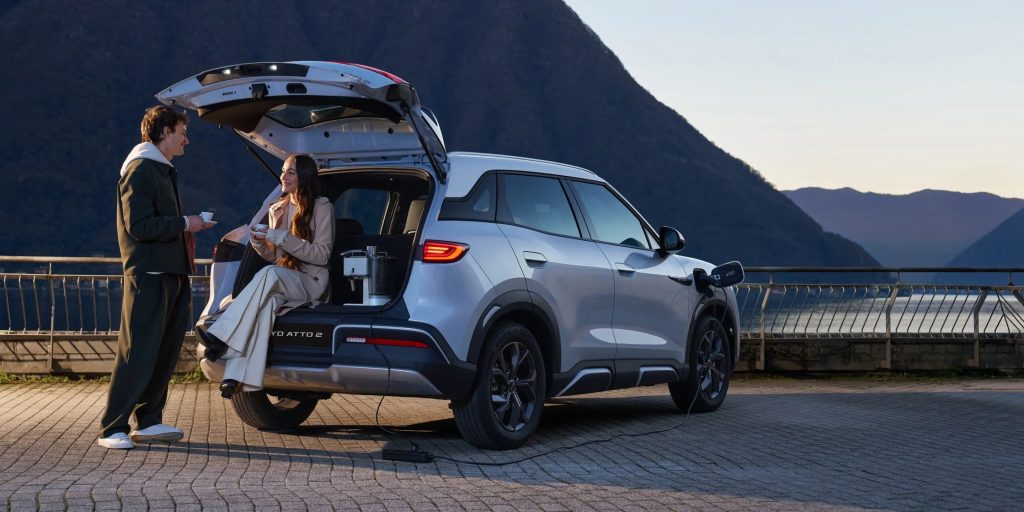
- 🔌 Some electric cars can power your camping equipment, laptop or even a kettle. Vehicle-to-Load (V2L) technology essentially turns your EV into a giant portable battery.
- 💡 Certain EVs can light up your campsite. Some models can power outdoor lights, speakers and even a projector for an outdoor movie night.
Government support has helped accelerate the switch
Government support has also helped accelerate the UK’s transition to electric driving. Low Benefit-in-Kind tax for fully electric company cars, the success of salary sacrifice schemes, the Zero Emission Vehicle (ZEV) Mandate and the £2 billion Electric Car Grant have all helped reduce barriers for drivers while encouraging manufacturers to bring more electric cars to market.
The Department for Transport said:
“The Government recognises the important role the fleet and rental sectors play… and the success of ZEV adoption through salary sacrifice schemes.”
Why are so many people switching?
Electric cars have become more popular because they now offer more choice, longer ranges, lower running costs, easier charging and a driving experience that many people genuinely enjoy.
For employees with access to a salary sacrifice scheme, the benefits can be even greater. It offers a simple way to drive a brand-new electric car while benefiting from Income Tax and National Insurance savings, a much lower benefit-in-kind tax and an all-inclusive motoring package.
Together, these changes have made electric driving a realistic and appealing choice for more people across the UK.
Ready to help your employees make the switch?
Discover how a Tusker salary sacrifice scheme could help your employees drive some of the UK’s most popular electric cars while saving Income Tax and National Insurance.
References
https://questions-statements.parliament.uk/written-questions/detail/2026-05-20/3404
https://www.gov.uk/guidance/changes-to-electric-vehicle-chargepoint-grant-schemes-from-1-april-2026
[1] https://www.iea.org/reports/global-ev-outlook-2026/trends-in-electric-cars
[2] https://energysavingtrust.org.uk/advice/electric-vehicles?loc=scotland
[3] https://tuskercars.com/ev-hub/read-our-driver-survey-report-2025/
[4] https://www.gov.uk/government/statistics/electric-vehicle-charging-infrastructure-statistics-1-april-2026/public-electric-vehicle-charging-infrastructure-statistics-1-april-2026
Last updated: August 2026